
Sources for Elk Grove Previous Residents
Past residents leave different kinds of traces. The assessor can anchor a parcel and current ownership, the recorder can identify title transfers, and a directory or census can place a household at an address. Elk Grove's municipal files are newer than its county property and court records, so the correct source depends on the date being studied. For previous residents, a sound house history keeps owner evidence and occupant evidence in separate columns.
Each source answers a different part of the trail. No source promises that every street appears in a directory or that every deed has an online image, so the custodian and date must be matched to the question.
| Source | Years It Covers | Where Held | What It Shows |
|---|---|---|---|
| Assessor current roll and viewer | Current assessment cycle | Sacramento County Assessor | APN, situs, mailing address, values, and controlled ownership information |
| Recorded Document Index | 1849-present | Sacramento County Clerk/Recorder | Party name, recording year, and document reference; no images online |
| Recorded deeds and related instruments | Deeds, deeds of trust, and liens since 1850 | Clerk/Recorder offices and copy requests | Grantor, grantee, recording data, and legal description |
| Elk Grove city permits | Mostly post-2000 | City Community Development, TRAKiT, and GovQA | Work type, site, issue date, and status; older files may be county records |
| Sacramento-area city directories | 1850-1990; reverse from 1914; telephone 1967-2019 | Sacramento Room and Center for Sacramento History | Named occupant or subscriber when the volume covered the address |
| Federal census | Public through 1950 | NARA and library databases | Household at the census date |
| Maps and Sanborn editions | 1880s through early 2000s; Sanborn 1884, 1891, 1895, 1905, 1912 | Sacramento Room and free online scans | Roads, subdivisions, footprint, use, and old layout; not occupant names |
Start with the recorder for a title question, the directory shelf for a named occupant, and the maps for a road or building question. Then compare the sources instead of asking one record to prove all three.
Elk Grove Address History Starts at APN
An address search should first become a parcel search. The Sacramento County Assessor Parcel Viewer accepts an address or APN and returns parcel placement, situs information, assessed values, tax-rate and land-use details, and limited characteristics. Use map navigation and identify tools to confirm the target shape, then note the APN exactly as displayed.
The public web result deliberately omits the owner name. Secured-roll ownership is public, but the county routes owner information through controlled channels. The Assessor lobby at 3636 American River Drive, Suite 200, is open weekdays from 8 a.m. to 5 p.m. Self-service computers are available there. Staff answer up to two identified parcel ownership inquiries per day by phone at 916-875-0700 from 8 a.m. to 4 p.m. or by email at assessor@saccounty.gov. Electronic rolls may also be requested through the county public-records request portal.
Record myth. Public ownership does not mean an owner-name list appears on the parcel website. The lobby, parcel-specific inquiry, or records request is the official next step.
Situs is the taxed property address; mailing is the address used for owner correspondence. A different mailing address may reflect a trust, an absentee owner, management, or a preferred mailing location. Neither field alone proves who lived at the property. The same parcel-first method supports the Elk Grove by-street address workflow when the question shifts from one house's history to the surrounding street.
Note: Record the APN, situs, mailing address, and map reference before searching a deed; they keep similar street names apart.
Deed Trail for Elk Grove Past Residents
The Sacramento Recorded Document Index covers recorded documents since 1849 and searches by party name plus recording year. It identifies a record but does not show the instrument image. A purchase deed supplies the next set of anchors: grantor, grantee, recording date, document number, and full legal description.
Work backward from the current owner, not forward from a guessed surname. The seller named in the purchase deed becomes the next name to search as an earlier grantee. Confirm the match with the legal description and APN before moving to another deed. A name alone is not a chain.
- Confirm the address, APN, situs, and current owner through the assessor's controlled channels.
- Use the current deed reference or recorder index to identify the purchase instrument.
- Write down both parties, recording date, document number, book or page reference, and legal description.
- Search the grantor as an earlier grantee in the recorded index, trying spelling variants separately.
- Compare APN, subdivision, lot, block, parcel map, or metes-and-bounds language to confirm the same land.
- Repeat the backward search until the online reference no longer resolves the needed instrument.
- Move to deed books, microfilm, an office counter, or a focused copy request when the web index is not enough.
- Grantor
- The person or entity transferring an interest in the instrument.
- Grantee
- The person or entity receiving the interest named in the instrument.
- Chain of title
- The linked sequence of transfers used to follow title from one holder to an earlier holder.
- Legal description
- The land description used in the instrument, such as a subdivision lot, parcel map, or metes-and-bounds description.
The deed chain identifies title history. It is one trail for previous residents, but it does not, by itself, identify every person who occupied the house.
Elk Grove Address History in Legal Descriptions
Street addresses are convenient but can be unstable across decades. Legal descriptions, APNs, subdivision names, lot and block references, and parcel maps help test whether a historic deed concerns the same land. The assessor map is an aid, not a legal boundary. Read the deed language before assuming that a modern address maps cleanly onto an older record.
Elk Grove road history makes this check especially important. Lower Stockton Road became Franklin Boulevard, Main Street became Elk Grove Boulevard, and the Bond Road and Laguna Boulevard corridor developed over time. Older records may use Sheldon, Franklin, Florin, or rural Sacramento County names rather than the present city label. Use maps from the Sacramento Room and the legal description together.
Sanborn maps add physical context. The 1884, 1891, 1895, 1905, and 1912 editions show building footprint, use, materials, hazards, and old street layout, but they do not identify occupants. A map can support continuity of a structure while a deed supplies the title parties and a directory supplies a household clue.
Note: A matching street number is not enough when a road changed name, a parcel was split, or an older description uses a different boundary.
Bridge Gaps in Elk Grove Address History
The recorder index is a party-and-year tool, not an image archive. Deeds, deeds of trust, and liens recorded since 1850 may be viewed at Clerk/Recorder offices or ordered by copy request. The main recorder office is at 3636 American River Drive, Suite 110, open weekdays from 8 a.m. to 5 p.m., 916-874-6334. The South service center is at 8239 E Stockton Boulevard and is open weekdays from 9 a.m. to 4 p.m.
Copies have a defined cost: the first page is $8, later pages are $1 each, certification is $1 per document, and self-service copies are $1 per page. A certified copy is a formal copy with certification; an ordinary copy is a readable reproduction. Select the kind of copy that matches the house-history question before paying for a request.
| First page | $8 |
|---|---|
| Additional pages | $1 per page |
| Certification | $1 per document |
| Self-service copy | $1 per page |
Before going to the counter, the Clerk/Recorder fee schedule gives the current copy categories used for a deed trail.
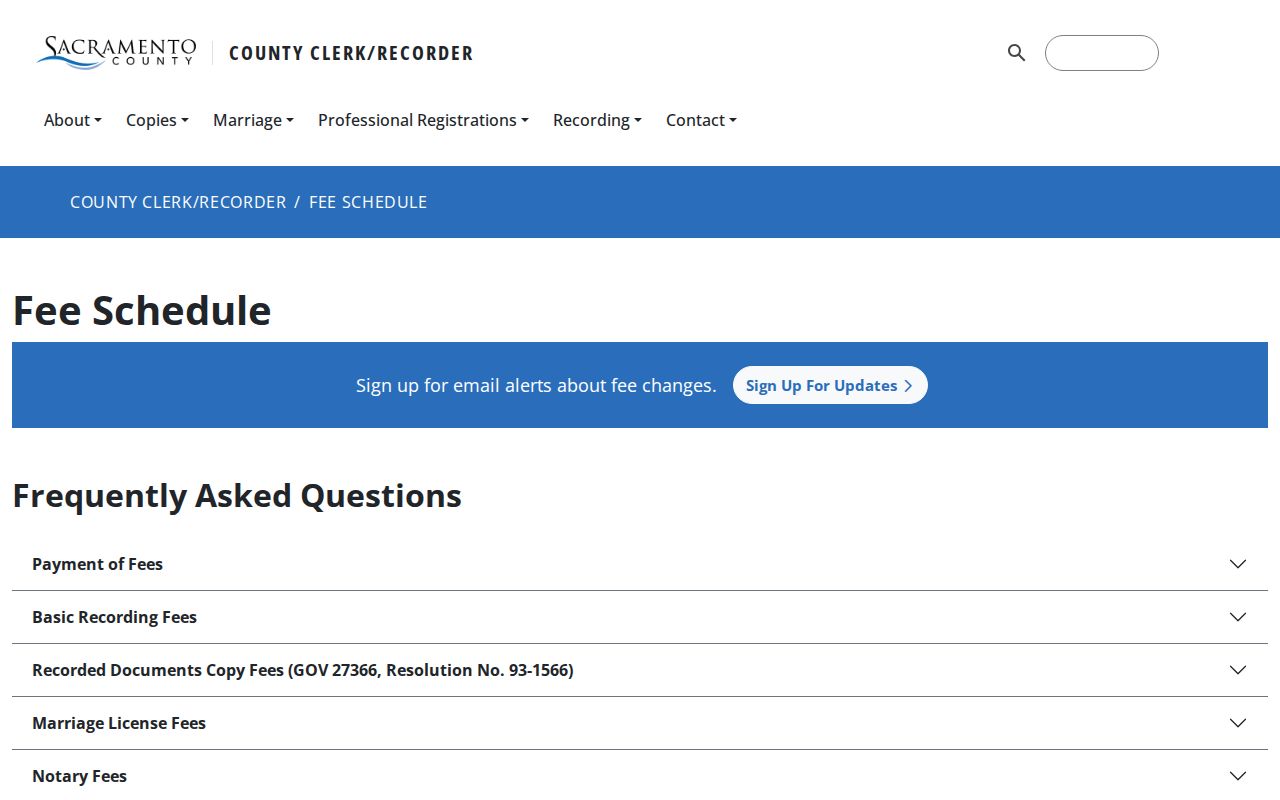
The fee reference belongs beside the document trail because the online index identifies the record while the counter or copy order supplies the instrument.
When a particular chain cannot be resolved online, ask the recorder about deed books, microfilm, the book and page reference, or a focused document request. The California State Archives at 1020 O Street in Sacramento holds selected historic state and local materials, but its catalog should be checked and staff contacted before assuming that an Elk Grove volume is present.
Elk Grove Address History Through Permits
Permit records help date a building or alteration, but they are not a list of everyone who lived at an address. Elk Grove's city permit trail is mostly post-incorporation. The city's public TRAKiT building-permit service describes issued permits and can expose address, permit number, work type, status, and issue-date fields. Its public ArcGIS service caps a query response at 1,000 records, so address and date filters matter.
Use the Elk Grove GIS maps to check city layers, planning projects, districts, and jurisdiction context. Map locations are approximate. Use Elk Grove public records and its GovQA route for plans, attachments, older files, code-enforcement records, or a defined date range. For work before incorporation, check Sacramento County rather than treating the absence of a city permit as proof that no work occurred.
Compare the permit date with the deed chain and the Sanborn or Sacramento Room map. A remodel can explain a changed footprint, while a directory or census can show who was associated with the place. These are separate layers of a house history.
Find Elk Grove Past Households
Ownership and occupancy split apart most clearly in historical directories. The Sacramento-area city-directory collection runs from 1850 to 1990, reverse sections begin in 1914, and telephone books extend from 1967 to 2019. Those dates describe the archive, not a guaranteed Elk Grove canvass. Check each volume for rural or suburban coverage before calling a name a past resident.
Directory entries can carry residence, owner or renter indicators, occupation, business and address, spouse, place of origin in early volumes, and telephone detail in later books. A reverse section can point from an address to a listed occupant. The full collection method and reading notes are in the Elk Grove city directory collections reference.
A listed occupant is still a dated clue. A previous residents search should treat a subscriber as one possible household member, not the whole household. A missing name may mean a move, death, omitted issue, or missing geographic coverage. Compare adjacent directory editions before drawing a conclusion.
Note: Directory evidence can reveal a household layer that the deed chain misses, but it cannot replace title records or prove present residence.
Elk Grove Previous Residents and Census
Directories and census schedules work best as paired snapshots. The directory gives an address, occupation, spouse, or subscriber clue; the census places a household at an enumeration date. The latest public federal population schedule is 1950, and the 1960 census release is expected in 2032. That leaves a clear boundary for older house-history work.
- Copy the directory entry exactly, including surname spelling, spouse, occupation, address, and any owner or renter mark.
- Check the nearest available edition before and after the census year to see whether the household moved or was skipped.
- Pair 1930, 1940, and 1950 directory observations with the matching census schedule and compare household members.
- Use the reverse section to search the address when a name-first entry is missing.
- Use maps and road-name history to explain a changed street label before treating two entries as different properties.
Census schedules are not deeds, and directories are not complete population counts. Agreement between them is stronger than either alone, but disagreement should be recorded rather than forced into a single story.
Elk Grove Obituaries and Probate
Obituaries and probate files can close a past-resident trail after a directory entry ends. The obituary may give a spouse, child, former address, or community connection. Probate can identify heirs and participants, but a probate role is not the same as occupancy. Match names, dates, and addresses to the deed and directory evidence.
The Tom Russell Research Library offers a hyperlocal route: ten surname drawers, files for churches, schools, cemeteries, clubs, businesses, events, and places, every Elk Grove High School yearbook from 1912 onward, and the full Elk Grove Citizen archive. Research is by two-hour appointment, and copies cost $0.25 per page. Its 916-685-8115 contact route is useful when a broad Sacramento directory never reached a particular rural address.
HeritageQuest, Newspapers.com, Ancestry Library, cemetery records, and Sacramento Room pamphlet files add leads. The library genealogy resources connect those databases with census, newspaper, military, and probate material. Verify a relationship or date against the custodian record before placing it in a house history.
Verify Elk Grove House History
A complete house history states what each source proves and what it does not. The assessor anchors the parcel and controlled ownership facts. The recorder shows title parties and transfers. Permits date physical work. Directories, census schedules, yearbooks, obituaries, and probate add household or community context. Safe at Home and other protected-record rules can end a trail, and protected addresses should never be reconstructed through cross-referencing.
Lawful house history. Previous-resident research in Elk Grove is appropriate for family history, architecture, stewardship, and personal curiosity. Do not use a record to stalk, harass, threaten, or track a living person or protected household.
The Sacramento County Sheriff inmate information page is a custody lookup, not a residence record. Custody data are not proof of guilt and do not show that a person lived at a particular Elk Grove address.
The official custody source is useful only as a reminder to keep unrelated records separate from a deed, directory, or household trail.
Federal proceedings sit in a different system. The PACER case locator can identify an Eastern District federal docket, but a docket is not a deed, parcel record, or proof of residence. If a prior owner appears in a federal case, treat it as a dated corroborating clue at most.
Keeping the federal, custody, title, and household layers distinct makes a past-resident conclusion easier to check and less likely to misidentify someone.
California's Safe at Home program exists for qualifying survivors and specified protected people. A lawful house history stops where confidentiality begins.